Monday Feb 28, 2011
Woke up again to blue skies which I was happy about because I would be going to such a depressing place and it would be nice to have some sun. It is hard to be excited for today since I am going to Auschwitz and Birkenau but as a persuer of knowledge I am excited to go.
The tour company, Escape 2 Poland, picked me up outside my hostel at 9 am and we proceeded to pick up the rest of the group. Next to be picked up was Michael from London, then Neil and Sue from Mancester, followed by a man from UK and finally two ladies from Liverpool. In the beginning of the trip we were eagerly getting to know each other and share information, but after 30 minutes of our journey, the driver put in the video of Auschwitz and for the remaining hour drive, no one said a word. What words would you say??? “Wow, great video”…no…”what did you think about that???”…no….silence was the only option.
The drive took about an hour and half from Krakow to Auschwitz. When we arrived, we met our tour guide and began the tour. There were people there but since it was winter, far fewer than in the summer season. I appreciated the fact that there weren’t that many people there because I wanted to take some pictures to show my students at home, and pictures with tourists in them would not have held the authencity.
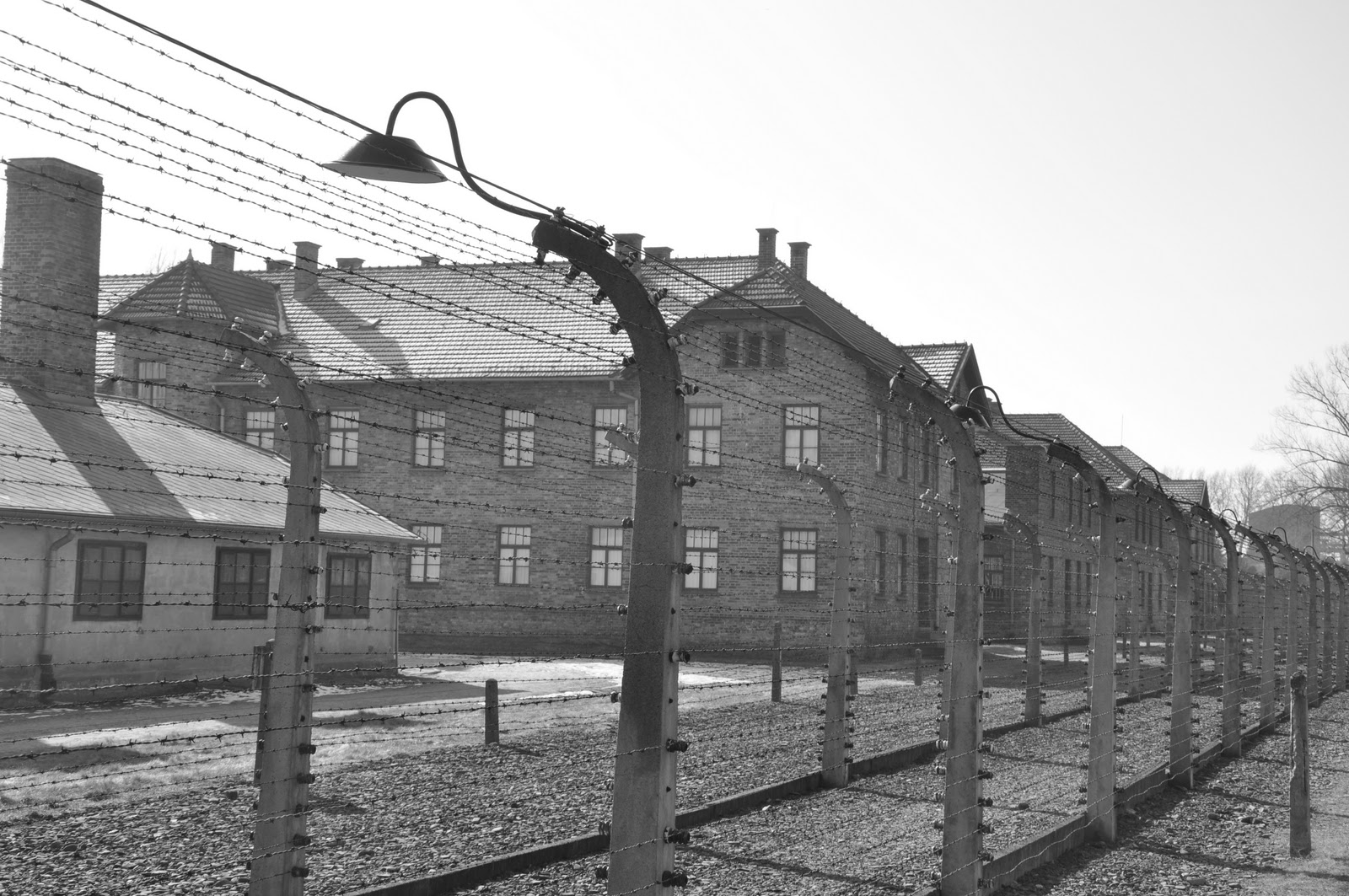
My first impression was of amazement. I was amazed that I was actually here. I have been teaching about Auschwitz for about ten years but my only experience with the concentration camp was through movies and text books. I was amazed that I was actually about to walk through the entrance to history myself and attempt to embrace the horrors that took place here. I was also amazed at the normalcy of the place. It looked “normal”. It seems so weird to say that but it looked like a regular military base…except for the barb wire that constantly reminded you where you actually were.
Our guide told us that the Nazis picked Auschwitz for three reasons. The first and most important reason was because Auschwitz is located between two rivers and the location was perfectly isolated from the rest of civilization. The second reason was because it was already built. It was originally built as a Polish Military Base before the war. Third reason is because of the train system. All tracks led to Auschwitz so it would be easy to transport prisoner to and from.
Life span of prisoners was around 6 months. The harsh winters, no food, starvation, diseases, you name it, took the life of many prisoners within 6 months. Every prisoner, which was not selected to be killed right away, was forced to work. There was no other option. They were to be slave labor for the Germans and they had to work. That was the only reason they were kept alive. In fact, Auschwitz was too “small” to house all the prisoners, so the prisoners were forced to build Birkenau to hold all the future prisoners. Auschwitz held about 100,000 prisoners and Birkenau was 30 times larger. I cannot even fathom what it must have been like to build your own “hell”.
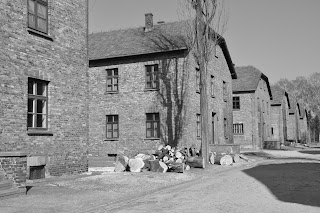

Auschwitz is maintained as a museum. All the buildings are original but the insides have been reconstructed to house museums and historical belongings. Auschwitz was actually the “Ritz” of the camps and prisoners there were much luckier than those housed at Birkenau. We toured a couple buildings and actual artifacts were displayed and it was so deflating to see the magnitude of belongings. When prisoners arrived at Auschwitz their belongings were taken from them, sorted by the Nazis, and housed in warehouses called Canada 1 and Canada 2. They were called that because Canada seemed as the land of “plenty” and that is what the Nazis felt about the prisoner’s belongings. There were “plenty” of items to sell and make money from. In one room, there was a glass case the length of the building and inside were 80,000 pairs of shoes. Shoes in good condition were sold or used by the Germans. The unusable ones were stored in the warehouse and the Nazis didn’t have enough time to destroy the evidence at the end of the war. You can see the types of shoes indicated that the prisoners didn’t know where they were going or for how long they would be gone. Many pairs of “summer shoes” and high heels and shoes you wouldn’t wear if you thought you would be out in the harsh winter weather for long. Regardless if they knew or not, they would not have been able to keep their shoes anyway so it is kind of a mute point.
Another part of the museum we saw Jewish Prayer Shalls, hair brushes, eye glasses, cooking supplies, children’s clothes/toys, and many other personal items taken from the prisoners. The prisoners were told they could take up to 50 kilos of belongings when they were taken from their homes so of course, they packed their best items, jewelrey, personal possessions, which were later stolen or sold by the Germans.
Cookware
glasses
hairbrushes
Luggage
braces
Starvation was a major cruelty to the prisoners. They were fed only 1500 calories a day. Breakfast entailed water with some sort of coffee powder. Dinner was meatless soup and a piece of black bread. Prisoners were slave labor so it was cheaper to starve them and save money on food because if they died, there would be plenty of new prisoners to take their place.


We toured Building 11. Building 11 is significant because it actually maintained the original interior and it was the horror building of the prisoners. It was the “Prison” of the prisoners. For no other reason, than looking sick, prisoners could be sent to the “prison” building. Inside an eerie chill filled the air and it was very hard to stay in one place very long. I am claustrophobic anyway, but my tolerance of the closed spaces was abnormally low. We went down into the basement and saw the “cells”. Cell 18 was where prisoners were put without food. It was known as the Hungar Cell. Cell 20 was the cell where they would cram up to 40 prisoners at once and they were forced to serve their “sentence” within that cell. The final cell we saw was at the end of the hall. They were known as the “standing cells.” Inside the small room were 4 smaller cells. The prisoners were forced to enter the small confined space through a door at the bottom of the cell that was no higher than my knees. The cell was only the size to stand in. Four prisoners were put together in the “standing cell” and forced to stay standing over night. I couldn’t stay in that room very long. Immediately I became claustrophobic and couldn’t breathe. I had to get out and left my tour group to view it a bit longer. We were told that during the experimentation with the Zyclone B gas, the put about 100 prisoners in the basement and dropped gas on them to kill them. After they were dead, the Nazis stressed about how to “explain” their mass death. Since they were trying to hide the truth, they wrote down that those 100 people died from a heart attack. 100 people all “died from a heart attack” the same day and time. Really??????
After going through Building 11 we went next door to the “shooting gallery.” Prisoners were taken to the basement of Building 11, told to undress and then taken out the side door to the shooting gallery. The windows on Building 10 and 11 were boarded up so prisoners could not see what was happening but there was no way to cover the sound. Also in the shooting gallery were two poles. Prisoners were hung from the poles with their hands tied behind their backs. After an hour of hanging, their arms were dislocated and they were no longer able to work, so they were shot.
Wall where prisoners where shot
These are the two poles they would hang prisoners with their hands tied behind their backs
Next we walked to Crematorium 1. Along the way, we were pointed out Rudolph Hoss’s (two dots over the O) house. His house was feet away from the Crematorium. He lived there with his wife and child and his child would play in their garden, just feet away from the inhumanity. The movie, Boy in the Stripped Pajamas was based off of him and his proximity to the camp. I can’t imagine how he explained the smell to his wife and child, who were unaware of what was really going on at Auschwitz. How could she not know??
800 people were killed at a time in Crematorium 1. They were led inside the gas chamber and gas was dropped from three openings in the celing. After being gassed, their bodies were loaded into the ovens by other prisoners and they were burned so as to “hide” the evidence. It was overwhelmingly emotional for me to stand in front of the ovens. When the war was ending, the Nazi’s destroyed the chimney and ovens, thinking they would be able to “hide” the evidence. They didn’t destroy the actual building. The chimney and ovens were reconstructed to perseve history. Did they think, that the allies would just “walk by” the crematorium and never discover what was happening inside? I was actually standing where millions of people were killed. That thought still brings a lump to my chest.
Inside the gas chamber
Gas cans used
Ovens
Ovens
At the end of our tour at Auschwitz we were told that in the beginning Poles were the ones brought to Auschwitz. Polish people, for no other reason than the Nazi’s needed their house, were put into the camp. Then Jewish people were brought in. All pregnant women, children under 14, and anyone unable to work, were immediately sent to the Crematorium. At the beginning they tried to separate mothers from their babies, but the mothers were putting up such a fuss, that the Nazis found it easier to just kill the mothers and the babies instead of dealing with the “headache” of trying to separate them. How could a mother willingly let go of her child??? Prisoners told incoming women to give their babies to the elderly so as to save their life. The baby and elderly would die anyways so a mother could survive if she wasn’t holding her baby. Again…how could a mother just hand over her child???
 |
| Roll Call area |
Final point we found out at Auschwitz was that EVERY SINGLE SS soldier working at Auschwitz volunteered to work there. It was the “best” job they could have and they wanted to be there. After the war, some SS soldiers tried to claim that they were “brain washed” by Hitler and forced to do what they did….uh…they VOLUNTEERED to do what they did. No one forced them to do anything!!!!!!
Oh…also criminals were also sent to Auschwitz…murders, etc. The criminals were allowed to do anything they wanted to the other prisoners, including the Jewish prisoners. If they happened to kill a Jewish prisoner, they were “rewarded”.
I have been asked what my feelings were at Auschwitz and I really don’t know how to answer that. It was a life changing experience and it will make me a better teacher because I will be able to teach it with first hand experience. My mom commented earlier that I am lucky that I can walk through Auschwitz freely and learn from what happened there because there was a time that men’s darkest evils took place at that camp.
I thought Auschwitz was life changing but it was nothing compared to the feelings that I felt at Birkenau.


 B3 is the men’s barracks and most of them were destroyed or broken down for materials at the end of the war. They reconstructed a couple buildings to perserve history and we had time to go look in them but I just couldn’t do it.